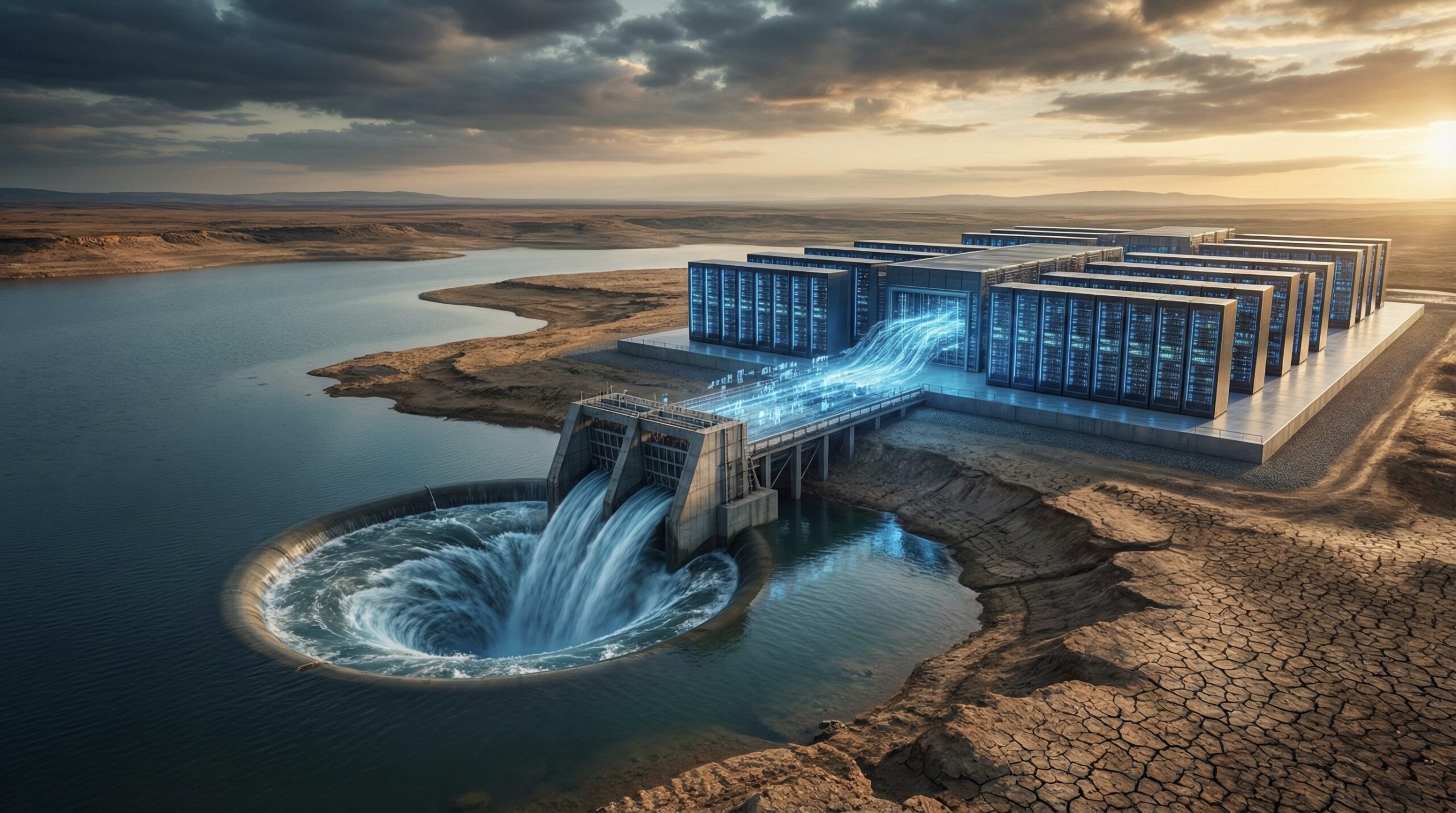
The invisible AI water footprint is becoming one of the most urgent environmental issues of our time, yet it rarely receives the same level of scrutiny as carbon emissions. While millions of users interact daily with artificial intelligence, few realize that these digital entities do not merely exist in an abstract “cloud.” In reality, that cloud consists of thousands of physical servers housed in massive data centers, all of which generate immense heat and require vast resources to function.
Beneath the sleek interfaces of chatbots and predictive algorithms lies a physical infrastructure that consumes natural resources at an alarming rate. As the demand for more powerful processing capabilities grows, so does the environmental cost attached to every query and command. This article explores the depth of the issue, revealing how artificial intelligence consumes water in massive quantities without most of us ever noticing.
Thermodynamics and the Thirst of Data Centers
The primary reason behind the massive consumption of water in the tech industry boils down to basic thermodynamics. Computer servers that run sophisticated AI models operate 24 hours a day, seven days a week, processing colossal amounts of data without rest. This incessant electrical activity generates extreme heat, which poses a significant threat to the hardware. Without effective temperature control, sensitive components would overheat, melt, or suffer permanent damage, leading to catastrophic system failures.
To combat this thermal challenge, technology companies rely heavily on industrial-scale cooling solutions. While air conditioning is used in some capacities, water cooling is the preferred method for high-density computing because water is far more efficient at absorbing and transferring heat than air. Consequently, the reliance on water becomes a fundamental operational requirement for keeping the digital world running smoothly.
The Mechanics of Cooling Towers
In many modern data centers, water is circulated through the facility to absorb heat generated by the server racks. Once the water has absorbed this thermal energy, it becomes hot and must be cooled down before it can be recirculated. This is where cooling towers come into play. These massive structures expose the heated water to the atmosphere, allowing a portion of it to evaporate. This evaporation process removes heat from the remaining water, effectively chilling it for reuse in the system.
However, this method comes with a significant environmental price tag. The water that evaporates into the atmosphere is essentially lost from the local watershed. It is consumed in the process and cannot be immediately returned to the local source for other uses. This evaporative loss constitutes the direct water consumption of a data center.
Furthermore, the volume of water lost through evaporation is substantial. For large hyperscale facilities, this can amount to millions of gallons of water annually. While the mechanism is efficient for cooling hardware, it places a heavy burden on local water supplies, particularly in regions where water is already a scarce commodity.
The Requirement for Potable Water
Another critical aspect of this cooling process is the quality of water required. One might assume that data centers could utilize wastewater or gray water for cooling purposes to save resources. However, the reality is more complex. The cooling systems in data centers involve intricate piping and narrow capillaries that circulate fluid close to sensitive electronics.
If the water contains impurities, minerals, or biological matter, it can lead to corrosion, scaling, or bacterial growth within the cooling infrastructure. These issues can clog the pipes, reduce cooling efficiency, and eventually damage expensive hardware. Therefore, to minimize maintenance risks and ensure operational stability, tech companies often utilize potable water—drinking-quality water that has been treated and purified.
This practice creates a direct competition between the needs of the tech industry and the basic needs of local communities. The same high-quality water that flows into the cooling towers of a data center is the water that could otherwise be used for drinking, cooking, or sanitation by residents. As the AI water footprint grows, this competition for fresh water resources is likely to intensify, raising ethical questions about resource allocation.
Analyzing the AI Water Footprint Lifecycle
Understanding the full scope of the environmental impact requires looking at the two distinct phases of an AI model’s life. The AI water footprint is not static; it accumulates during the initial creation of the model and continues to grow every second the model is used by the public. Both phases contribute significantly to the total volume of water consumed, though they do so in different ways and at different scales.
Researchers and environmental scientists are now beginning to quantify these impacts more precisely. By breaking down the lifecycle into “training” and “inference,” we can better understand where the most intensive resource consumption occurs and identifying potential areas for efficiency improvements.
The Training Phase: A Massive Upfront Cost
The first phase is known as “training,” which is the period during which an AI model learns to understand and generate human-like responses. This process involves feeding the algorithm billions of parameters and datasets, requiring thousands of high-performance Graphics Processing Units (GPUs) to run at maximum capacity for weeks or even months.
During this intense computational marathon, the heat generation is immense, requiring constant, aggressive cooling. Research indicates that training a single large language model, such as GPT-3, can consume approximately 700,000 liters of fresh water. To put this figure into perspective, that amount is roughly equivalent to the water needed to manufacture hundreds of electric vehicles, such as Teslas or BMWs.
Moreover, this figure often only accounts for on-site cooling and does not always include the water used to generate the electricity powering the training run. When the full supply chain is considered, the water cost of training a single state-of-the-art model becomes staggeringly high. As companies race to build even larger and more capable models, the water consumption for training is expected to rise exponentially.
The Inference Phase: The Cost of a Conversation
The second phase, known as “inference,” occurs when the model is deployed and users begin interacting with it. This is the phase where you ask ChatGPT, Gemini, or Claude a question, and the system processes your input to generate an answer. While a single query might seem computationally light compared to training, the sheer volume of global interactions creates a massive aggregate impact.
Recent estimates from university researchers suggest that a simple conversation with an AI chatbot roughly consisting of 20 to 50 questions and answers consumes approximately 500 milliliters of water. This is equivalent to a standard single-use bottle of mineral water. While pouring out one bottle of water seems negligible, one must consider the scale of adoption.
With millions of active users engaging with these platforms daily, the cumulative AI water footprint becomes enormous. If 100 million users engage in a short conversation every day, the water consumption rivals that of a mid-sized city. This “inference” consumption is continuous and grows linearly with user adoption, making it a long-term sustainability challenge that may eventually surpass the initial training costs.
Indirect Consumption via Power Generation
Beyond the direct cooling of servers, there is a hidden layer to the water footprint: energy generation. AI servers are incredibly power-hungry, and the electricity that feeds them must be generated somewhere. Whether the power comes from coal, natural gas, or nuclear plants, the energy sector is traditionally water-intensive.
Thermoelectric power plants require vast amounts of water to cool their steam turbines. Therefore, every kilowatt-hour of electricity consumed by an AI model carries with it a “water price tag” from the power plant. This indirect water usage is often overlooked in corporate sustainability reports but is an integral part of the total environmental equation.
Consequently, transitioning to renewable energy sources like wind and solar, which require far less water for operation, is critical. Until data centers are fully powered by water-efficient renewable energy, the indirect water consumption will remain a major component of the industry’s environmental impact.
Critical Challenges and Future Solutions
The intersection of technological advancement and resource scarcity presents a complex dilemma. The AI water footprint is not just a technical metric; it is a socio-economic issue that affects communities, particularly in drought-prone areas. As climate change exacerbates water scarcity globally, the expansion of water-hungry data centers is facing increasing resistance and regulatory scrutiny.
However, the industry is not standing still. Recognizing the urgency of the situation—and the potential for public relations backlash—major technology companies are investing in innovative solutions. From engineering breakthroughs to strategic geographic planning, efforts are underway to decouple the growth of AI from the depletion of freshwater resources.
Location and Water Stress
A major compounding factor in this crisis is the physical location of data centers. Historically, many large tech hubs were established in areas that offered tax incentives or proximity to fiber-optic backbones, regardless of local water availability. This has led to the construction of massive facilities in water-stressed regions like Arizona and California in the United States.
In these arid climates, water is already a precious resource. When a tech giant sets up a facility that draws millions of gallons from the local aquifer, it competes directly with farmers who need water for irrigation and residents who need it for daily survival. This competition creates tension and raises questions about the equitable distribution of resources.
Moving forward, site selection must prioritize water sustainability. We are seeing a shift where companies are considering the “hydrological stress” of a region before breaking ground. Building in areas with abundant water or cooler climates is becoming a necessary strategy to mitigate the social and environmental impact of the AI water footprint.
[External Link: World Resources Institute on Water Stress by Country]Technological Innovations in Cooling
To address the inefficiency of evaporation-based cooling, engineers are developing new technologies. One promising approach is “adiabatic cooling,” a technique that uses air to cool the servers for the majority of the year. This system only utilizes water evaporation when the ambient air temperature rises above a certain threshold, drastically reducing annual water usage.
Even more revolutionary is “immersion cooling.” In this method, server racks are fully submerged in a specialized dielectric fluid. Unlike water, this fluid does not conduct electricity, so it does not damage the electronics. It is incredibly efficient at absorbing heat directly from the chips.
Immersion cooling eliminates the need for water evaporation entirely, potentially reducing the cooling-related water footprint to near zero. While the initial setup cost is high, the long-term operational savings and environmental benefits make it an attractive option for the next generation of supercomputing centers.
Corporate Commitments to Water Positivity
In response to growing pressure, tech giants like Microsoft, Google, and Meta have announced ambitious environmental goals. A key concept emerging from these commitments is becoming “Water Positive” by 2030. This pledge goes beyond merely reducing consumption; it aims to replenish more water than the company consumes.
Strategies to achieve this include investing in wetland restoration projects, improving local water infrastructure to reduce leaks, and funding technologies that recycle wastewater. By treating and reusing water within their own facilities and contributing to watershed health outside their walls, these companies hope to neutralize their impact.
While these commitments are promising, transparency remains crucial. Historically, specific data on water usage per AI model has been kept proprietary. For these goals to be credible, companies must provide clear, verified data that allows independent researchers to track progress and hold the industry accountable for its AI water footprint.
The rapid evolution of artificial intelligence has brought undeniable benefits to society, from medical breakthroughs to productivity enhancements. However, these advancements come with a tangible physical cost that can no longer be ignored. The water consumed by data centers represents a significant strain on our planet’s freshwater reserves, necessitating a fundamental shift in how we design and operate digital infrastructure. As consumers and citizens, understanding this hidden cost is the first step toward demanding more sustainable practices.